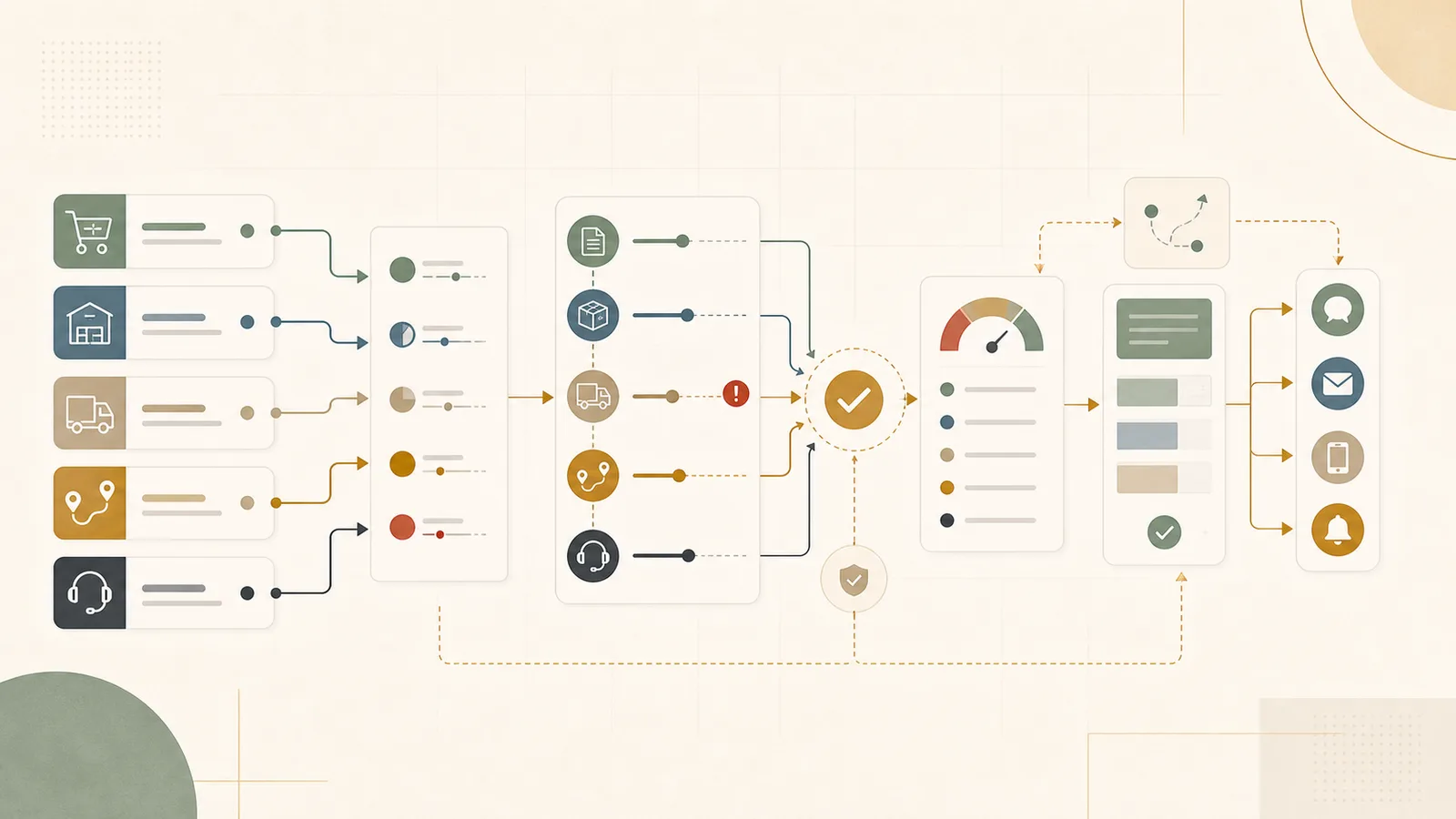
A customer emails to ask where their order is. Support opens the order screen, sees a delivery date, and hesitates, because last week that same date turned out to be wrong. So support messages the warehouse. The warehouse says the pallet has not been picked yet. Someone checks the carrier portal, which shows no pickup appointment. Three people now hold three versions of the answer, and the customer is still waiting for one they can plan around.
This is the real shape of delivery ETA communication. It looks like a customer service problem, and it gets measured like one, usually as response time. But the deeper issue is that the company gives different answers to the same question depending on who happened to check. Every time that happens, trust leaks, even when the shipment eventually arrives on time.
Who gets the "where is my order" question
This usually lands on a customer service leader, an operations manager, an ecommerce owner, a logistics lead, or a founder who still reads the support inbox. They see the same pattern repeat several times a day. A customer asks where the order is, support asks operations, operations checks the warehouse or the carrier, and the reply that goes out depends on who was free to answer and what screen they happened to look at.
The person who owns this is rarely short of information. The company has an order system, a warehouse system, a carrier portal, and a support tool. The problem is that no single answer pulls those together, so the human in the middle becomes the integration layer, and that human is expensive, slow, and easy to interrupt.
The real cost is an inconsistent promise
Slow replies are annoying. Inconsistent promises are what actually cost you the customer. If support says Friday, the warehouse says the order is not picked, and the carrier says there is no appointment yet, the customer does not experience one late shipment. They experience a company that does not know its own operation. The next time they order, they build in a buffer, chase earlier, or start pricing an alternative supplier.
There is a quieter cost too. Every time support has to stop and ask operations for a real date, two teams lose time on a question that has no new information in it. The warehouse lead answers the same "is this really shipping today" three times before lunch. Multiply that across a busy week and a chunk of two teams goes into re-checking things that a shared answer could have settled once.
What a trustworthy ETA answer actually holds
A good ETA answer is not just a date. It carries four things: what is known, how sure you are, what could still change, and how to say that to the customer. Support and sales do not need direct access to the warehouse system or the freight forwarder. They need a reviewed answer that says what the source shows, how much weight to put on it, and what the customer should expect next.
Put plainly, the answer separates the fact from the promise. The fact is "the pallet is picked but the carrier has not scanned a pickup." The promise is "your delivery window still holds, and we will confirm once the carrier collects today." The first is operational truth. The second is a commitment, and a person should still own it. When those two get collapsed into a single copied date, that is where overpromising starts.
How the question moves through the building today
In most companies, the current process runs on manual escalation. Traced end to end, a single "where is my order" question tends to move like this:
- The customer asks, often for the second time, because the first automated tracking update was vague or already out of date.
- Support opens the order and sees an expected date, with no way to tell whether that date is real or aspirational.
- Support messages operations to check. Operations looks at the warehouse system, the carrier portal, or the freight forwarder, depending on the shipment.
- Someone writes a reply from what they found, in their own words, with their own read on how confident to sound.
- Later, the status changes. Nobody proactively tells the customer, so the next contact is another inbound question, and the whole thing starts again.
This works when the company is small and one or two people carry the whole picture in their heads. It breaks as volume grows, shipments split across carriers, exports add document steps, and the people who knew everything are on leave or buried in a peak week.
Where ETA communication breaks
The failures are predictable, and naming them makes them easier to fix one at a time.
The date gets copied without its confidence
An expected date from the order system gets pasted into a customer reply as if it were certain. The customer reads it as a commitment. Nobody attached the caveat that the pallet is not picked or the carrier slot is not booked, so a normal operational wobble reads as a broken promise.
Warehouse and carrier status never gets translated
"Pick complete, awaiting carrier scan" is meaningful to operations and meaningless to a customer. When the raw status goes out untranslated, it either confuses the customer or gets dropped, and support falls back to a vague "it is on the way" that helps nobody plan.
Customers hear about delays only after they chase
When a carrier pushes an appointment or a replenishment slips, the person who owns the customer relationship usually finds out when the customer complains, not when the status changed. The company had the information first and still let the customer discover the delay on their own.
The people answering cannot see who the customer is
A key account and a one-off order get the same generic handling because commercial context is not visible where the exception is being worked. The customer who deserves a phone call and a workaround gets a templated apology, and the account manager hears about it later from an unhappy client.
Every answer starts from a blank page
There is no record of what was already told to this customer, by whom, or when the next update is due. So each reply is rebuilt from scratch, promises drift between messages, and the customer occasionally gets two different dates from two different people on the same day.
The smallest version worth building
You do not need a new platform to fix this. The smallest useful version is a shared ETA view for an order or shipment that shows the latest source status, a confidence state, the caveat, the reviewed customer-facing answer, the owner, and when the next update is due. Add a short set of confidence states so not every date is presented as equally solid, a handful of reviewed message drafts for the situations that keep recurring, and a simple way to feed what the customer was told back to operations.
The point is not to make every ETA certain. Some genuinely are not. The point is to make the uncertainty visible and consistent, so support stops guessing and customers stop getting confident answers that later fall apart.
Give every ETA a confidence state
The single highest-value change is usually the smallest: stop presenting every date as a firm promise. A short, shared set of confidence states lets support answer honestly without escalating, and lets operations flag the ones that genuinely need a human look before anything goes out.
| Confidence state | What it means inside operations | What support can safely tell the customer | Who moves it next |
|---|---|---|---|
| Confirmed | Shipped and scanned by the carrier, tracking live | Give the delivery window with confidence | No action unless tracking changes |
| Likely | Picked and packed, carrier pickup expected today | Hold the window, note it confirms once the carrier collects | Logistics coordinator watches for the pickup scan |
| At risk | A dependency is slipping, such as a split shipment or a tight carrier slot | Flag the risk early and give a revised date range | Support lead, with an operations check |
| Delayed | A milestone has already been missed | Acknowledge the delay, give the new date and the reason | Account owner for priority customers |
| Waiting on the carrier | Ready to ship, no pickup appointment confirmed | Say it is booked with the carrier, confirm the collection date once set | Logistics coordinator |
| Needs review | Sources disagree, or a document or customs gate is open | Hold the promised date until operations clears it | Operations manager |
The states matter less than the discipline. Six clear labels that everyone reads the same way beat a precise-looking date that three people would each defend differently.
The few fields the answer actually depends on
A trustworthy ETA joins the commercial promise to the operational truth. That does not mean piping every field from every system into one place. It means pulling the small number of fields that decide whether a date can be trusted and how the customer should be told. Start from the answer you need to give, then connect only the sources that feed it.
| Where it lives | The few fields that decide the ETA | Who owns keeping it current |
|---|---|---|
| Order system, ERP, ecommerce, or CRM | Order, promised date, customer, account priority, service notes | Customer service or commercial owner |
| Inventory and warehouse system | Availability, allocation, pick status, pack status, holds, ready to ship | Warehouse or fulfillment lead |
| Carrier, TMS, parcel, or freight forwarder | Pickup, in-transit, appointment, delay, delivery, proof of delivery | Logistics coordinator |
| Support and communication tool | Prior questions, promises already made, next update due | Support lead |
Most teams already have all four systems. The work is not buying more software. It is agreeing which fields are load-bearing, who keeps each one honest, and how they meet in a single view a support agent can trust without a side conversation.
A worked example: the regional distributor
Say a regional distributor runs around 300 deliveries a week across three carriers, a mix of wholesale pallets, split ecommerce orders, and the occasional export that needs paperwork. The numbers here are illustrative, chosen to show the shape of the problem rather than any real company. On a normal Tuesday, support is fielding forty ETA questions, and roughly half turn into a message to the warehouse or a check of a carrier portal.
The team builds one shared ETA view, updated from the order, warehouse, and carrier systems, and adds the six confidence states. Three live orders on that Tuesday show how it changes the answer support can give without escalating.
| Order or shipment | Latest signal from the source | Confidence | Reviewed answer to the customer | Next owner |
|---|---|---|---|---|
| Wholesale pallet leaving the regional warehouse | Pick complete, carrier pickup not yet scanned | Likely | Delivery window holds, confirms once the carrier collects, expected by end of day | Logistics coordinator |
| Split ecommerce order, two cartons | One carton shipped, the second waiting on replenishment | At risk | Send a partial-shipment note now, with a firm date for the second carton | Support lead |
| Export delivery with documents pending | Freight booked, commercial invoice still under review | Needs review | Hold the promised date until the document check clears, then confirm | Operations manager |
None of these answers required support to interrupt the warehouse. The pallet is honest about the pending scan instead of promising a hard time. The split order gets a proactive partial-shipment note before the customer notices only one box arrived. The export is held back from a false promise while the paperwork clears. The gain is not that every date became certain. It is that support could answer all three from one place, and each customer got a message the operation could actually stand behind.
Reviewed messages for the situations that repeat
Most ETA questions are variations on a handful of situations. Writing a good reply from scratch every time is slow and inconsistent. A small set of reviewed message drafts, agreed with operations and the commercial team, gives support approved language for the common cases and a clear line for where a human still has to make the call.
| Situation | What the customer actually needs to hear | What stays a person's call |
|---|---|---|
| Confirmed delay | The new date, the reason in plain terms, and what you are doing about it | Whether to offer a discount, expedite, or a call for a key account |
| Partial shipment | What is arriving now, what is following, and the date for the rest | Whether to split the invoice or waive a second delivery charge |
| Missing document or customs hold | That the shipment is paused, why, and the realistic next checkpoint | What to promise before the document gate has actually cleared |
| Appointment change or missed delivery | The revised slot and how to confirm it works for them | Whether to escalate with the carrier or reroute the shipment |
The drafts speed up the routine answers. The right-hand column is the part that protects you: it keeps the genuinely commercial decisions, the ones with money or a relationship attached, in front of a person instead of buried in a template.
Move from answering late to telling customers early
Once a shared view exists, the biggest shift is from reactive to proactive. Today most updates are triggered by a customer chasing. With a view that knows when a status changed, you can flip it: when an order moves from likely to at risk, or a carrier pushes an appointment, the update goes out before the customer asks.
Start narrow. Proactive updates are most valuable on the exceptions, the split orders, the delays, the held documents, not on every shipment that is running fine. A confirmed, scanned parcel does not need a personal message. An at-risk key-account order does. Aim the early warning at the situations where silence is what actually damages trust, and leave the smooth ones to normal tracking.
Where AI helps inside this workflow
AI earns its place here by translating operational status into a clear first-draft message and by watching for changes a person would otherwise have to catch by eye. It drafts, highlights uncertainty, and points to the source. The team still approves what goes out.
In practice, that means a few concrete jobs. It can summarize what changed in an order, warehouse, or carrier status since the last customer update, so support reads a short note instead of three portals. It can draft a customer-ready reply in the approved tone, with the right caveat attached to the right confidence state. It can sort inbound questions by situation, such as delayed shipment, partial shipment, missing tracking, or a proof-of-delivery request, so the right template and owner are ready. And it can flag the low-confidence ETAs that need an operations look before support responds. Every one of those is a first pass a person reviews, not an answer that ships on its own.
Where the promise stays a person's call
There is a hard line in this workflow, and it is worth stating plainly. AI can read, group, and draft. What you promise a customer stays a person's decision. A model can tell you the pallet is picked but not scanned. Whether you commit to Friday, offer to expedite, or call the client first is a judgment about the relationship, the account, and the risk, and that judgment belongs to your team.
This matters most on the exceptions, which is exactly where the pressure to automate is highest. A delayed key account, a customs hold on a high-value export, a second missed delivery to an already-frustrated customer: these are the moments a wrong automated promise does real damage. Keep the routine confirmations fast and assisted, and keep the commitments that carry money or a relationship in front of a person who can own them.
Traps that keep ETA answers manual
A few mistakes tend to pull teams back into the manual pattern even after they try to fix it.
Trying to connect every system at once
The instinct is to integrate everything before giving support a better answer. It stalls. Connect the few fields that decide the ETA for one shipment type, prove it helps, then widen. A view that covers your busiest lane well beats a half-built one that covers everything badly.
Automating the promise, not just the draft
Letting the system send committed dates without review feels efficient until it confidently promises a date the operation cannot hit. Keep the human on the promise. Automate the gathering and the first draft, not the commitment.
Presenting every date as equally certain
If the new view drops the confidence states and just shows dates, you have rebuilt the original problem with a nicer interface. The states are the part that keeps support honest. Do not quietly trade them away for a cleaner-looking screen.
Building it for the dashboard, not the agent
An ETA view that impresses a manager in a review but takes an agent four clicks to read during a live chat will not get used. Design it for the person answering the customer in the moment, or it becomes another screen nobody opens.
How Ubisar would implement this workflow
In week 1, Ubisar would pick one place where ETA questions are creating the most repeated interruption: a customer segment, a shipment type, or a single busy channel. We would trace one question from the order promise to the warehouse cutoff, the carrier milestone, the document gate, the support ticket, and the message that finally went out. The first thing to exist is a single ETA view for that slice, showing source signal, confidence state, caveat, the reviewed customer answer, the owner, and when the next update is due.
In weeks 2 and 3, we would connect only the order, warehouse, carrier, document, and support fields needed to keep that view current, and add the confidence states and reviewed message drafts. AI would help summarize status changes and draft the customer replies, while your operations team keeps the confidence rules and the exception calls. By week 4, support and sales should be able to answer live ETA questions from the view and send a proactive note when an exception order changes, without pulling a warehouse lead off the floor.
At the end of month one, keep going if customer answers are faster, more consistent, and less dependent on private message threads, and narrow or stop if the source milestones still disagree and the view cannot be trusted. This is the shape of Ubisar's AI, Data & Tech Implementation service: connect the data and the review around one workflow without replacing your core logistics tools, starting from $4,000/month, month-to-month, cancel anytime. The manual work cost guide helps estimate the value of cutting manual support escalation before you commit, and if the fit looks right, tell us the workflow and we will start from there.
Useful next links
ETA communication sits downstream of several other workflows, and unclear customer answers often trace back to one of them.
- Read the supply chain exception reporting guide when ETA issues need to feed a wider daily exception queue.
- Read the warehouse pick-pack handoff guide when your ETA confidence depends on how cleanly pick and pack hand off.
- Read the freight booking and document workflow guide when carrier milestones and paperwork are what drive the customer answer.