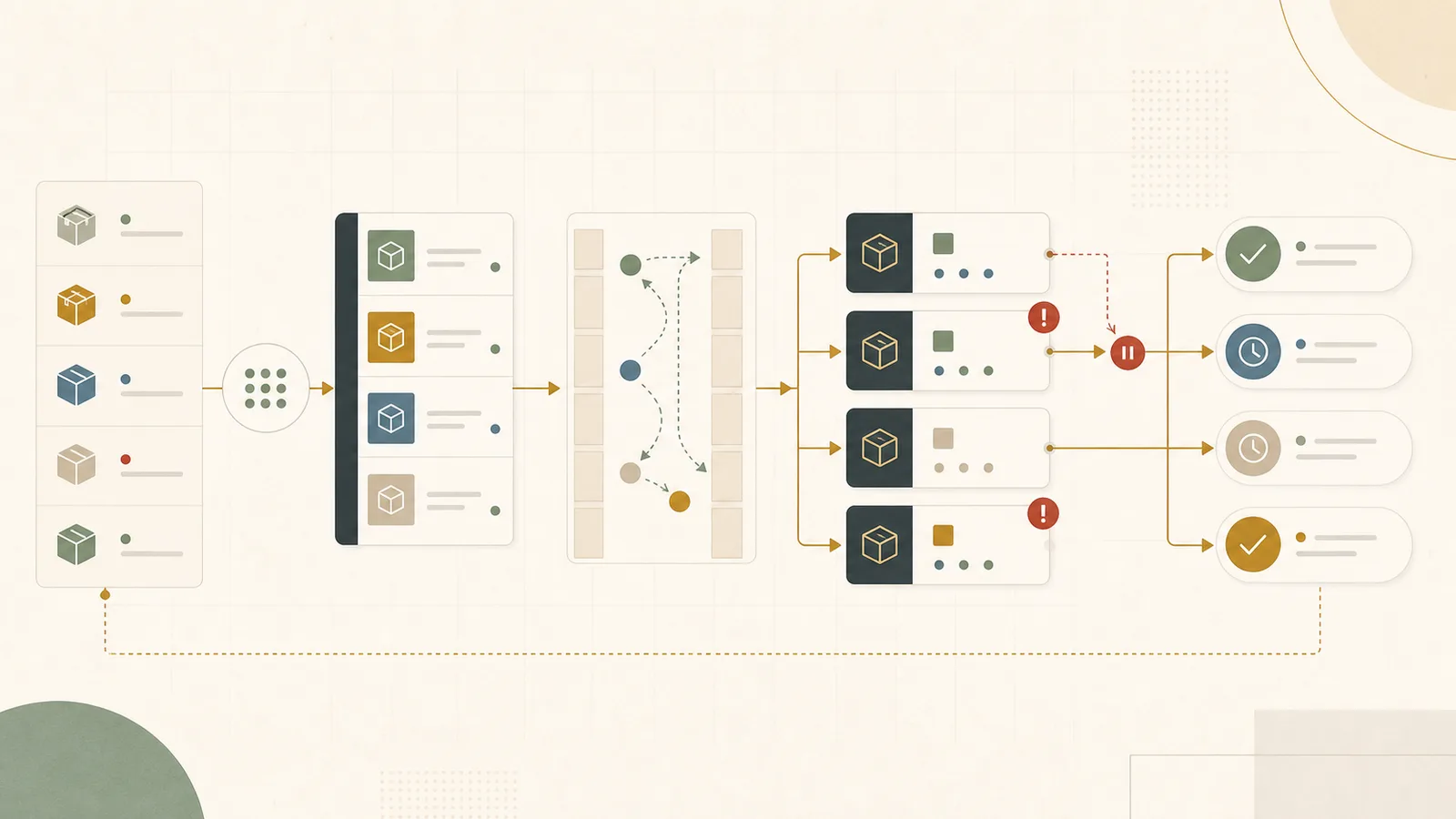
By mid-morning the floor is already moving and nobody is quite sure the day will land. The wave dropped an hour ago, pickers are working the aisles, packers are waiting on totes that have not arrived yet, and the carrier cutoff is a fixed point on the clock that does not move for anyone. Somewhere in that flow an order is stuck, and the people who need to know about it, sales, support, the customer, will find out last.
The pick-pack handoff is where a customer promise turns into physical work. An order was taken, a date was given, and now someone has to make the stock, the pick task, the packing spec, and the carrier all agree before the truck leaves. When those pieces move together, the warehouse feels calm even when it is busy. When they do not, the operation finds out through missed cutoffs, late status checks, and customer follow-up it could have avoided.
Who feels this first
This usually lands on a fulfillment manager, a warehouse operations lead, a shift supervisor, a distribution center manager, or an ops director. In a smaller operation it might be the founder who still walks the floor. What they have in common is that they are judged on whether orders ship on time and correct, and they carry that pressure whether or not the systems help them see it.
They do not want a warehouse automation pitch before the basic handoff is reliable. They want to know, at any point in the day, which orders can still ship, which are blocked and why, and which promises are at risk before the cutoff. That question sounds simple. In most buildings it takes a walk to the floor and three conversations to answer.
This matters most at a particular moment: order volume has grown past the point where a supervisor can hold the whole picture in their head, but the operation is nowhere near ready to rip out and replace its warehouse management system. The tools mostly exist. The handoff between them is still held together by people and memory.
Why a pick-pack problem is really a handoff problem
When ship-on-time slips, the instinct is to look for a slow step. Picking is too slow, packing is short-staffed, the printer jammed. Sometimes that is the whole story. More often the individual steps are fine and the trouble lives in the gaps between them.
Each team along the flow holds a partial truth. Order management shows the order as open and promised for tomorrow. Inventory says the stock is on hand. The warehouse system has a pick task, a wave, a hold, or a short pick against it. Packing sees a carton size, a label, or a compliance document that is missing. The carrier has a pickup window and a manifest. Customer service sees only the promise date and, when a customer asks, has to go find someone who knows.
Every one of those views is correct in isolation. The handoff breaks when they are not joined before the cutoff, and you end up with a hardworking operation where everyone is doing their job and no one has a calm, current view of what is going to miss. The fix is rarely more effort on any single step. It is making the state of each important order visible to the people who can act on it, while there is still time to act.
Walk the handoff from order drop to ship confirmation
It helps to trace one order through the building and name the point where each team hands to the next. The stages below are the common shape of an outbound flow. The exact labels differ by warehouse, but the handoffs are almost always the same.
Order release and wave planning
An order arrives from the store, the marketplace, or the sales system and sits as released. Before anyone can touch it, it has to be planned into a wave and allocated to stock in a specific location. This is the first quiet handoff, and the first place a problem can hide. If allocation runs against inventory that is on a quality hold, in the wrong location, or not yet replenished to the pick face, the order looks ready in the office and is not ready on the floor. Nobody notices until a picker is standing in front of an empty slot.
The pick face
Once a wave releases, pickers get tasks. A clean pick is uneventful: go to the location, take the quantity, confirm, move on. The handoff strains when the picker finds less than the task asked for, finds nothing, or finds the wrong item in the slot. That discovery is real-time information about a promise at risk, but in many buildings it goes no further than the handheld and the supervisor. Purchasing, planning, and customer service learn about it much later, if at all.
Pick to pack
Picked stock moves to packing, and packing has its own gate. The carton or mailer has to be right, the packing instruction has to exist, and any brand or compliance requirement has to be met. A same-day order that is picked but waiting on a missing polybag or a labeling rule is not a picking problem anymore. It is a packing hold, and it is invisible to anyone reading pick reports.
Pack to stage
Packed cartons move to staging to wait for their carrier. Staging is supposed to be a short holding step. It becomes a problem when it turns into a second warehouse, full of finished cartons that are technically done but not yet confirmed, some of them missing a document, a label, or a manifest line. The floor looks productive because cartons are stacking up. The promise is still not kept until the carrier takes them.
Carrier handoff and ship confirmation
The last handoff is the one customers actually feel. The carrier collects, the manifest closes, and the system confirms the shipment. Until that confirmation posts, the order is not really shipped, no matter what the packing station believed an hour ago. When ship confirmation lags the physical truth, tracking numbers go out late, customer updates are wrong, and support answers questions with stale information.
Where the handoff actually breaks
The stages above show where handoffs sit. The failures below are the recurring patterns that turn a normal day into a scramble. They cut across the flow, which is why fixing one stage in isolation rarely helps.
Short picks that travel too slowly
A short pick is a small event with a large blast radius. One empty location can mean a stockout, a count error, a mis-slot, or stock stuck on a hold. Each of those needs a different response, and the right response often belongs to someone who is not on the floor. When that information sits in the handheld for two hours before purchasing or customer service hears about it, the cheap fix, a quick replenishment or a proactive customer note, is already off the table.
Blockers found at the pick face instead of before the wave
Holds, missing documents, and allocation problems are usually knowable before a picker is dispatched. But if nothing checks for them at release, the wave goes out anyway and the blocker surfaces as wasted travel. The picker walks to a location that cannot be picked, comes back, and the order re-enters the queue with less time on the clock than it had an hour ago.
Cutoff risk that stays invisible until it is too late
Most operations can tell you at the end of the day what missed. Far fewer can tell you at 11 a.m. what is trending toward a miss. Without a view that ties each order's state to its cutoff, the day is managed by whoever shouts loudest, not by which orders are genuinely closest to breaking their promise.
Staging that turns into a second warehouse
When cartons pile up in staging with unresolved issues, the operation loses the ability to trust its own completion numbers. A carton in staging might be ready to ship or might be missing a customs document. If both look the same, staging stops being a quick step and becomes a place where problems go to be discovered late.
Ship confirmation that lags the truth
The gap between "physically loaded" and "confirmed in the system" is where support gets caught out. A customer asks where their order is, tracking shows nothing, support says it has not shipped, and meanwhile the carton left two hours ago. The promise was actually kept. The record did not keep up, so it reads as a miss.
Priority handled by favor instead of a visible rule
When a big customer's order is at risk, it usually gets rescued through a phone call and a favor. That works until two important orders are at risk at once and the operation has no shared way to decide which one wins. Priority that lives in relationships rather than in a visible rule is priority that breaks under load, which is exactly when it matters most.
A worked example: two apparel brands under one roof
This scenario is illustrative, not a real client, and the numbers are here to make the shape concrete.
Say a third-party logistics operator picks around 900 order lines a day for two apparel brands out of one building. Brand A sells mostly two-day orders. Brand B runs frequent same-day promotions with a hard early-afternoon cutoff and its own branded packaging. Both brands sit in the same warehouse system, but each has its own promise rules and its own idea of what "on time" means.
On a normal promotion day, the morning wave for Brand B releases fine. Twenty minutes in, a picker hits an empty location for a hot SKU. The stock shows on hand, so it is probably a count error or units stuck in receiving. That single short pick affects forty same-day orders, all against the same early cutoff. Nobody outside the aisle knows yet. Meanwhile, a batch of Brand A orders is picked and waiting at packing because the branded polybag that Brand B also uses has run low, and packing quietly reprioritized. By early afternoon, the supervisor is firefighting two problems that were both visible hours earlier if anyone had been looking at the right screen: a replenishment gap on one SKU and a packaging shortage shared across brands.
None of this requires a new warehouse system. It requires the short pick, the packaging shortage, and the cutoff clock to be visible in one place early enough for a person to make a call: run an emergency replenishment, split the shipment, substitute the packaging, or tell the customer now rather than after the cutoff has passed.
The order states worth tracking
The heart of a reliable handoff is a small, shared idea of what state an order is in. Not the twenty statuses a warehouse system can produce, but the handful that tell a human whether a promise is safe and who owns the next move.
| Order state | What it means on the floor | Who owns the next move | Where it commonly stalls |
|---|---|---|---|
| Released, not allocated | Order dropped, stock not yet committed to a location | Wave planner or inventory lead | Waiting on replenishment, or the only stock is on hold |
| Allocated, not picked | Pick task exists and is waiting for a picker | Pick team lead | Short pick, empty location, or wrong item in the slot |
| Picked, not packed | Stock is at packing, carton not yet built | Pack supervisor | Missing packing spec, packaging shortage, or a quality check |
| Packed, not staged | Carton is built, label or document pending | Pack or ship clerk | Label not printed, compliance or customs document missing |
| Staged, not confirmed | Carton is at the dock waiting for the carrier | Shipping clerk | Manifest still open, carrier scan not yet posted |
Once everyone agrees on these states, the conversation changes. Instead of asking "is the order ready," the team can ask "which state is it in, and who has the next move," which is a question a board can answer without a walk to the floor.
What a pick-pack handoff board holds
The practical output is a handoff board for the orders that matter most that day. It does not replace the warehouse system. It sits around the order, inventory, and carrier data and makes the handoff readable while there is still time to act. The rows below are illustrative.
| Order | State | Blocker | Promise risk | Next move and owner |
|---|---|---|---|---|
| Two-day order, Brand A | Allocated, not picked | Pick location empty, replenishment not run | Safe if replenished by noon | Run replenishment, inventory lead |
| Same-day order, Brand B | Picked, not packed | Branded polybag out of stock | At risk after the early cutoff | Substitute or notify, pack supervisor |
| Next-day bulk order | Staged, not confirmed | Manifest open, one line short-shipped | Low if the short line is confirmed | Close manifest, shipping clerk |
The value is not the table itself. It is that a blocker now has a reason, an owner, and a cutoff attached to it, instead of living inside a warehouse note or an email thread where non-warehouse teams cannot reach it.
Planning the wave against the cutoff clock
Most pick-pack pain traces back to how waves are planned. A wave built purely by zone efficiency or pick density will happily send the floor after a hundred easy lines while a cluster of same-day orders drifts toward a cutoff it will not make. The picks look productive. The promises still break.
A better approach plans the wave with the cutoff clock in view. That does not mean abandoning pick efficiency. It means checking, before a wave releases, whether the orders in it can realistically be picked, packed, staged, and handed to the carrier in the time left, and flagging the ones that cannot so a person can decide what to do. Sometimes the answer is to pull an order into an earlier wave. Sometimes it is to accept that it ships tomorrow and tell the customer now. The point is that the choice is made deliberately, early, by someone who can see the whole picture, rather than discovered at the dock when the truck is already loading.
This is also where the handoff board earns its place: if each wave carries the few orders closest to their cutoff, the supervisor can watch those specifically instead of holding every order in their head.
Handling short picks without stopping the line
Short picks deserve their own attention because they are the single most common way a good day goes sideways, and because the right response almost never belongs to the picker alone. The question a short pick raises is not "what is missing" but "what do we do about this promise, and who decides." The table below shows the common cases.
| What the picker finds | The real question | Who decides | What the customer should see |
|---|---|---|---|
| Location empty, stock shown on hand | Count error, mis-slot, or genuine stockout? | Inventory lead | Nothing, if caught and replenished before the cutoff |
| Partial quantity available | Ship short now or hold for the full order? | Customer service, using the account rule | A split shipment or a clear short-ship note |
| Damaged units at the face | Pull from another location or substitute? | Pack or quality check | A possible swap that needs approval first |
| Wrong item in the slot | Fix the slot or re-pick elsewhere? | Inventory and pick lead | A short delay if the re-pick is not fast |
What makes short picks manageable is speed of routing, not a clever algorithm. The moment a picker records a short, the right person needs to see it with enough context to act: which orders it affects, which cutoffs are involved, and whether a customer decision is needed. That is a data and tools problem, and it is very solvable without touching the warehouse system's core.
The data and systems to connect
Before any of this can be automated, the identifiers have to line up. Order IDs, pick ticket IDs, shipment IDs, item numbers, location codes, and customer references frequently do not match cleanly across systems. A stable join between the commercial promise and the warehouse reality is the unglamorous groundwork that makes everything after it possible.
In practice, a working handoff usually needs to read from four places: the order or ecommerce system for order lines, promise dates, customer priority, and release status; the inventory and warehouse system for stock, allocation, holds, wave and task status, packing status, and locations; the carrier or parcel data for labels, pickup windows, and manifest status; and the support or account data for escalations, service commitments, and any account-specific packing or shipping rules. None of these needs to be perfect. They need to agree on which order they are talking about.
The tools usually involved
Most warehouses already own more of the necessary pieces than they realize. There is typically a warehouse management or execution system, an order management or ecommerce platform, an ERP or inventory system, carrier and shipping software, handheld or scanning devices, and a pile of spreadsheets and messages that quietly hold the parts the official systems miss. On top of that there may be a labor management tool, a slotting tool, or a returns system.
The useful question is not which of these to replace. It is which handoff between them is slowing the operation down, and what minimum connection or view would make that one handoff reliable. A handoff board is often a thin layer that reads from the systems already in place, rather than a new system that competes with them.
Where AI helps inside the handoff
AI is useful here at the edges of the handoff, not in the middle of execution. It can read messy blocker notes and group them by likely reason, so a hold recorded as free text becomes a category a supervisor can scan. It can summarize which high-priority orders changed state since the last cutoff check, so the person managing the day starts from what moved rather than re-reading everything. It can draft the internal note that tells sales or support what is blocked and what is being done, ready for a person to check and send. And it can point out recurring blocker themes over weeks, the same SKU going short, the same packaging running out, the same location causing mis-picks, so the operation can fix causes instead of symptoms.
What AI should not do is quietly decide what ships or promise a shipment the source data does not support. The handoff involves customer commitments and physical constraints, and both belong to people. AI drafts, groups, and flags. It does not get to keep or break a promise.
What stays a person's call
The line is worth stating plainly, because it is what makes the whole thing safe to adopt. Software can show that an order is short, that a cutoff is close, or that a document is missing. It cannot decide whether to split a shipment, substitute a product, hold an order for a full pick, or tell a customer the promise has moved. Those calls depend on the account, the relationship, and judgment the system does not have.
A good handoff board makes those decisions easier and earlier by putting the facts in front of the right person while there is still time. It does not make the decision. The team keeps the choice about what ships and what a customer is told.
Start with one flow, not the whole warehouse
The mistake that sinks these projects is trying to fix the entire building at once. The better first move is to pick one flow where the pain is obvious and the promise is clear: ecommerce outbound for one brand, wholesale orders, spare parts, or a single distribution center. Follow real orders through release, wave, pick, pack, stage, and carrier handoff, and write down where each one actually loses time.
That single trace usually reveals more than a month of meetings: which handoff is fragile, which data is missing, and which decisions are made too late. Once one flow is reliable, the pattern extends to the next, and the operation has a working example instead of a slide about warehouse modernization.
A practical first four weeks
A focused first month is usually enough to move from firefighting to seeing the day before it breaks. Depth matters more than breadth here: one flow made genuinely reliable beats a shallow view across the whole warehouse.
| Week | Focus | What should exist by the end |
|---|---|---|
| Week 1 | Follow one flow from order drop to ship confirmation | A handoff record with order, state, blocker reason, cutoff, owner, source links, and the next move |
| Weeks 2 to 3 | Join the minimum order, inventory, warehouse, and carrier data and build the board around the cutoffs the team already works to | A live handoff board that reads real status and flags orders trending toward a miss |
| Week 4 | Run a real cutoff check from the same board | Sales, support, and the floor reading the same status without a walk to the aisle |
By the end of the month, the test is simple. Can the team run a cutoff check from one shared view, catch promise risk earlier than they used to, and route short picks to the right person while it still helps? If yes, keep going and extend to the next flow. If the blocker is still inconsistent states in the warehouse system or unclear ownership on the floor, fix that first, because no board can paper over a handoff nobody owns.
How Ubisar would implement this workflow
In week one, Ubisar would pick one warehouse flow and follow orders through release, wave, pick, pack, stage, short pick, and carrier handoff. The first output would be a handoff record that captures order state, blocker reason, cutoff time, promise risk, owner, source links, and the next communication needed, built from how the operation already works rather than from a template.
In weeks two and three, we would connect the minimum order, inventory, warehouse, carrier, and support data that record needs, then build the handoff board around the cutoff checks the team already runs. AI would help group blocker notes, summarize what changed since the last check, and draft reviewed updates for sales and support, while what ships and what a customer is told would stay tied to source data and a person's call.
By week four, sales, support, planning, and the floor should be able to run a real cutoff check from the same board. We keep going if the workflow cuts status checks and catches promise risk earlier, and we narrow or stop if the real blocker turns out to be inconsistent warehouse states or unclear ownership, because those come first. Ubisar would build this inside the AI, Data & Tech Implementation service, one month at a time, fixing the workflow together with the data underneath it and the tools around it. If your team is chasing status instead of shipping to it, tell us the flow that keeps breaking and we can start there. The pricing page shows how the monthly engagement works.
Useful next links
The pick-pack handoff sits between what happens inside the building and what the customer hears. These adjacent guides pick up where this one ends:
- Read the customer delivery ETA communication guide when support needs a better customer answer built from warehouse status.
- Read the freight booking document guide when the trouble starts earlier, at the booking and paperwork stage before the dock.
- Read the inventory reorder visibility guide when the root cause is stock availability or purchase-order timing rather than the handoff itself.