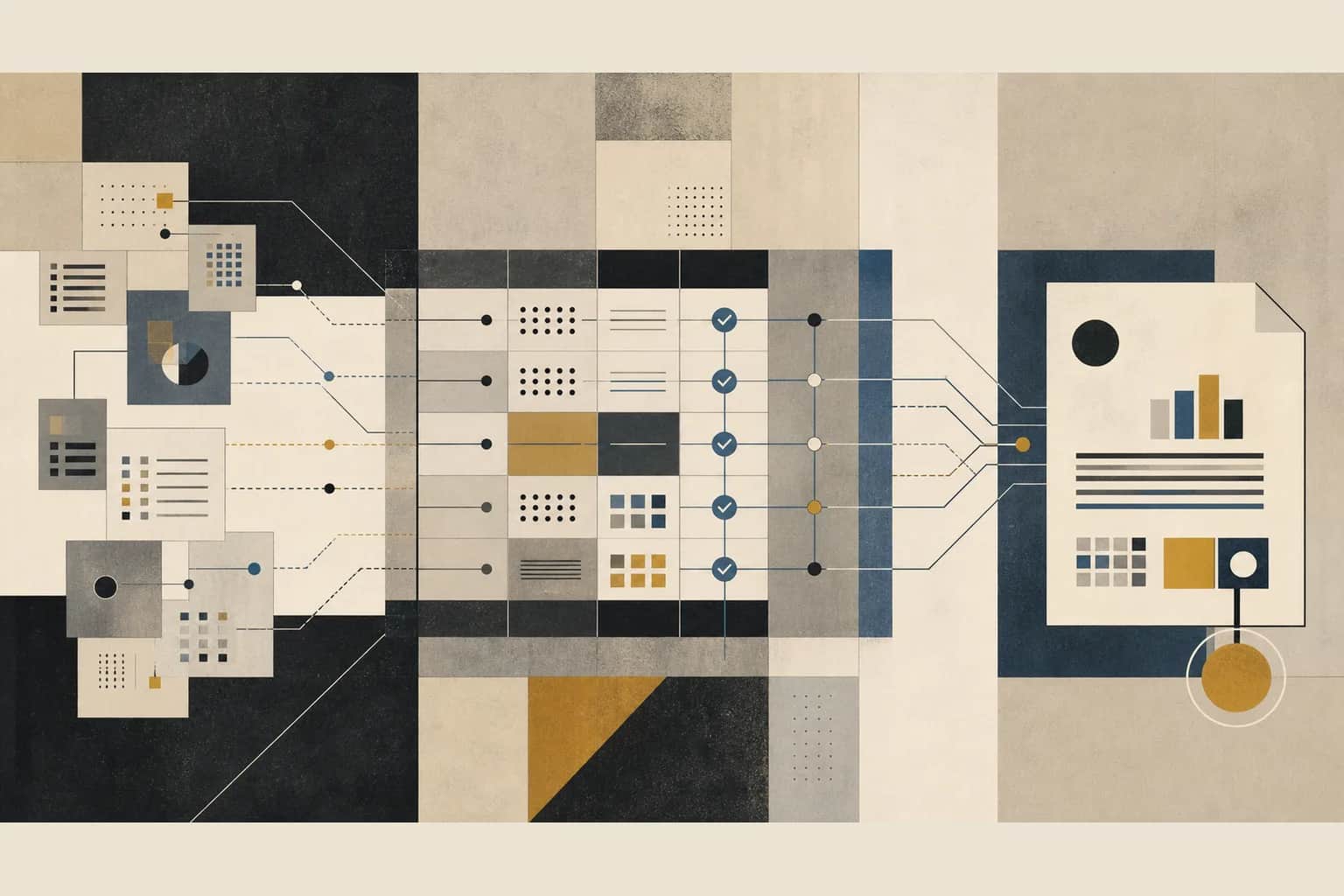
The review sample lands on a Monday. By Friday, most of the week has gone into finding the evidence rather than judging it.
A batch of policies, claims, or marketing pieces gets pulled for review. Someone opens the policy admin system to confirm the wording. Someone else digs through the claims system for the adjuster notes. A call recording is in a third platform, the approval sits in an email thread, and last quarter's finding on the same broker is in a spreadsheet nobody has opened since. The compliance team can do the actual review well. What eats the time is assembling proof of what happened before anyone can judge whether it was right.
If you run compliance or operations inside a regulated insurer, MGA, or broker, this is probably familiar. This guide is about making that review faster and more repeatable, so it strengthens the business instead of turning into a separate reporting factory that everyone dreads.
What the review is actually trying to do
A compliance review does not replace professional judgment or the interpretation of your obligations. Those stay with qualified people. What a good workflow does is make the mechanical parts repeatable: select the work, gather the evidence, record the outcome, assign the issue, and show whether the fix is actually moving. When those five things are reliable, the reviewers spend their attention on the hard calls instead of on the scavenger hunt.
The failure you are trying to avoid is the one where the review produces a verdict but no usable trail. A finding that says "documentation gap" with no link to the file, no owner, and no due date is a finding that will be rediscovered and re-argued next cycle. The point of the workflow is to stop the same issue being found, reworded, and rechecked in three different places.
A test to run before you build anything
Pick one item from your last review and try to trace it end to end. Can you see the policy, claim, or communication that was reviewed, the source evidence behind it, who assessed it, what they decided, who owns the fix, and whether that fix has closed? If any link in that chain lives only in someone's memory or inbox, the review is not yet reviewable, and that is the part worth fixing first.
Follow one review item from sample to closed issue
Before changing anything, map how one item actually moves today. Take a single policy, claim, communication, or transaction from the moment it is selected to the moment its issue is closed, and watch where the handoffs get fragile. In most insurance teams the path looks something like the table below, and the last column is where the week disappears.
| Step | Who runs it | Source it pulls from | Where it usually breaks |
|---|---|---|---|
| Define scope and sample | Compliance manager | Review calendar, prior findings, risk assessment | Sample choice is ad hoc, so cycles are not comparable |
| Pull the sample | Compliance analyst | Policy admin, claims, complaints, marketing systems | Exports done by hand and hard to reproduce |
| Gather the evidence | Analyst and first-line owner | Document management, email, call recordings | Evidence chased across systems and inboxes |
| Assess against the requirement | Reviewer | Policy manual, regulatory reference, prior guidance | Judgment captured as free text nobody can aggregate |
| Record the finding | Reviewer | Review template or spreadsheet | Severity and root cause captured inconsistently |
| Raise and track the issue | Compliance and business owner | Issue tracker, email, meetings | Ownership drifts and due dates slip |
| Report and close | Compliance lead | Management pack, board or committee report | Pack rebuilt from scratch every cycle |
The shape of this is sensible. The problem is almost never the assessment step. It is that the evidence and the finding separate too early, and the reporting at the end has to reassemble a story the systems could have held all along.
The review types that sit under one workflow
Compliance review is not one activity. A single team may be checking marketing claims one week, claims handling the next, and broker conduct the week after. Each type asks a different question and pulls from a different system, which is exactly why the evidence ends up scattered. Naming the types clearly is the first step to building something that can serve more than one of them.
| Review type | What compliance is checking | Where the evidence sits |
|---|---|---|
| Marketing and financial promotions | Claims are fair, clear, and not misleading; required disclosures present; approvals recorded before publication | Asset library, approval logs, website CMS, email platform |
| Policy wording and customer letters | Wordings match the approved version; renewal, cancellation, and mid-term letters say the right thing | Policy admin system, document management, correspondence templates |
| Claims handling | Decisions follow policy terms and fair-treatment duties; timelines met; declines reasoned and recorded | Claims system, adjuster notes, call recordings, payment records |
| Complaints handling | Complaints logged, categorized, resolved in time, and root causes captured | Complaints log, correspondence, call recordings |
| Underwriting and pricing conduct | Decisions within delegated authority; eligibility and pricing applied as approved; exceptions recorded | Underwriting workbench, rating logs, referral records |
| Distribution and delegated authority | Brokers and MGAs act within their authority; disclosures and suitability handled correctly | Binder agreements, bordereaux, broker correspondence, audit files |
You do not need one workflow that handles all six on day one. You need one that handles the first one well and can take the second without being rebuilt from nothing. Picking the type where the pain is loudest is more useful than trying to cover the whole program at once.
Where the evidence actually lives
The reason evidence gathering is slow is rarely that the evidence is missing. It is that it is spread across systems that were never meant to talk to each other. A single reviewed item can touch the policy administration platform for the contract, the claims system for the file, a document store for the signed forms, a call recording platform for the customer conversation, an approval log for the sign-off, and someone's inbox for the exception that was granted last quarter.
Each of those systems is fine at its own job. None of them was built to answer "show me everything behind this one reviewed item." So the reviewer does it by hand, and the trail they build lives in a working spreadsheet that is complete for exactly one cycle and then goes stale. Before you automate anything, it is worth writing down, for one review type, which systems hold the records you keep reaching for. That list is what the workflow has to connect, and it is usually shorter than people expect.
Where the review loses its week
The breakpoints are predictable. They show up in slightly different forms depending on the review type, but the underlying patterns repeat.
Sample selection is done by hand
When each cycle's sample is pulled manually, two things happen. The pull itself takes hours, and the logic behind it is hard to defend later. If an auditor or regulator asks why these fifty claims and not others, "the analyst exported what they could" is a weak answer. Sampling that is defined once and repeatable makes the review comparable across cycles and far easier to stand behind.
Findings are free text nobody can add up
A reviewer writes a paragraph describing what they found. It reads fine on its own. But when management asks how many documentation gaps appeared this quarter, or whether the same root cause keeps recurring, nobody can answer without reading every note again. Findings that carry a structured category, severity, and root cause alongside the reviewer's words can be counted and trended without a second manual pass.
Ownership drifts after the finding
The moment a finding leaves compliance and becomes an issue for the claims manager or the marketing lead to fix, it tends to fall into email and meetings. Due dates slip quietly. By the next review the same gap is still open, and now it looks like a repeat failure rather than a fix in progress. Issues that carry an owner, a due date, and a visible status from the moment they are raised are the ones that actually close.
The management pack is rebuilt every cycle
If the review record is trustworthy, the board or committee summary should assemble itself from what is already there: findings by severity, overdue items, recurring themes, remediation status. When it does not, someone spends the last two days of the cycle rebuilding the pack from scattered notes, which is time taken directly from the review itself.
Recurring issues never reach the first line
The most expensive failure is the quiet one. A control break shows up in three consecutive reviews, gets remediated three times, and is never fed back to the team that keeps causing it. Compliance treats the symptom; operations never sees the pattern. A workflow that surfaces repeat findings to the first-line owner turns review from a scoreboard into something that actually changes how the work is done.
A worked example: a regional MGA checking its own communications
Say a regional managing general agent writes motor and small commercial business on behalf of two carriers, and its compliance lead runs a quarterly review of marketing materials and customer communications. This example is illustrative, not a real client, but the shape will be recognizable.
The quarter's sample covers renewal letters across the motor book, a direct-mail campaign, the website quote journey, and a set of broker emails. Today the reviewer opens each asset, hunts for the version that was actually sent, tries to confirm it was signed off before it went out, and checks the wording against the carriers' requirements and fair-value duties. The renewal letters are in the policy admin system, the campaign is in the marketing tool, the sign-offs are in email, and the carrier requirements are in a PDF someone saved locally. Three days in, the reviewer has read everything but has written down almost nothing structured.
Now picture the same review with the evidence linked. Each sampled communication carries a link to the version sent, the approval record, and the requirement it is being checked against. The reviewer reads and judges; AI has already pulled the matching version, flagged the two flyers with no approval record, and drafted a plain-language note on each. The reviewer confirms or overrides every call. What comes out is a finding record like this.
| Review item | Evidence status | Finding | Accountable owner |
|---|---|---|---|
| Renewal letter, motor book | Complete | Fair-value wording missing on two variants | Product manager |
| Direct-mail flyer, Q2 campaign | Missing sign-off record | Cannot confirm approval before send | Marketing lead |
| Website quote journey | Complete | No issue found | Compliance reviewer |
| Broker email, commercial lines | Under review | Possible non-disclosure of commission basis | Distribution lead |
The judgments here are still human. What changed is that the reviewer reached them in a day instead of a week, and every row already has an owner and a status, so the remediation starts the moment the review closes instead of after another round of chasing.
Structure the finding record before you build a dashboard
It is tempting to start with the management view, because that is what leadership asks to see. That instinct builds the wrong thing first. A dashboard is only as honest as the records feeding it, and a green summary sitting on top of unstructured notes is worse than no summary at all, because it invites confidence the evidence does not support.
Build the finding record first. Get one review type to the point where every item has a clear scope, linked evidence, a structured outcome, an owner, and a closure status. Once that record is trustworthy for a single type, the reporting on top of it becomes a byproduct rather than a separate build. The order matters: record, then reporting, never the reverse.
What the review record should hold
The record does not need to be elaborate. It needs to connect evidence, decision, issue, owner, and closure so that no part of the review depends on someone remembering. For a single review type, that usually means capturing the following.
| Part of the record | What it holds |
|---|---|
| Scope | Review population, sample logic, the requirement being tested, reviewer, business owner, and due date |
| Evidence | Source documents, approvals, customer communications, policy or claim references, and prior related findings, each linked to the item |
| Finding | Outcome, severity, root cause, the policy or regulatory reference, and the reviewer's note |
| Remediation | Owner, action, due date, evidence required to close, and closure confirmation |
| Reporting view | Management summary, trend by severity and root cause, overdue items, and recurring themes, drawn from the records above |
Notice that the reporting view holds nothing new. It is a reading of the first four rows. If you find yourself entering data directly into the summary that does not exist in the records beneath it, that is the sign the record is incomplete, not that the summary needs more fields.
Where AI helps, and where a person still decides
This is the line that matters most in insurance, and it is the same line the sector page draws. AI is good at reading, sorting, extracting, and flagging. It is not the place where regulated decisions get made.
What AI can safely do
Inside a compliance review, AI earns its place on the mechanical work. It can summarize a claim file, an adjuster's notes, or a customer thread so the reviewer starts from a clear picture instead of raw scroll. It can extract dates, approvals, required fields, and missing documents from source records. It can propose a finding category and severity for the reviewer to confirm. It can draft the review note, the remediation reminder, and the first pass of management commentary. And it can flag the things a human eye tires of catching: missing evidence, overdue remediation, a finding that has now appeared three cycles running.
What stays with the accountable owner
Whether a communication is misleading, whether a claim was handled fairly, whether an underwriting decision sat within authority, whether a control has genuinely failed: these are decisions, and in a regulated business they belong to named, accountable people. AI reads the file and sorts the sample and flags the outlier. The person decides, and the workflow keeps a record of who decided what and when. That record is not bureaucracy. It is the thing that lets you answer the auditor's real question, which is not "what does the system think" but "who signed off on this, and on what basis."
Keeping this boundary explicit is also what stops a fast summary from being mistaken for a reviewed conclusion. A clear-sounding AI note is a starting point for judgment, never a substitute for it, and the workflow should show the reviewer's confirmation on every finding that carries weight.
The checks that catch a weak review before it ships
Small automatic flags do a lot of quiet work. They are cheap to build once the record is structured, and they catch the errors that are embarrassing precisely because they are obvious in hindsight. A few that consistently earn their place: an item marked reviewed with no evidence linked, a finding with no owner, a remediation past its due date with no closure note, a finding marked closed with no confirming evidence, and the same root cause appearing across consecutive cycles. None of these require judgment to detect. Letting the workflow raise them means the reviewer spends their judgment on the findings themselves, not on policing whether the record is complete.
A cadence that keeps evidence and reporting together
The review does not need constant reporting. It needs the right cadence for the work. A practical one keeps the evidence and the summary from drifting apart: reviewers link evidence and record findings as they go rather than at the end, so the record is current on the day the review closes; issue owners update remediation status on a set interval so nothing goes silent for a month; and the management or committee summary is generated from the record rather than assembled by hand. The test of the cadence is simple. If the board pack still takes two days to build the week it is due, the record and the reporting have separated again, and that gap is where the next weak cycle starts.
What to measure
Keep the measures close to the pain you started with. The share of review items that had complete evidence at first pass tells you whether the gathering problem is actually shrinking. The time spent finding evidence versus judging it tells you where the week is still going. Findings broken down by severity, root cause, and owner tell you whether the same problems keep returning. Overdue remediation and repeat findings tell you whether issues are really closing or just being reopened. And the time it takes to prepare the management summary tells you whether the record is doing its job. If those numbers move in the right direction, the workflow is working, whatever the dashboard looks like.
Common traps
A handful of mistakes make this harder than it needs to be, and they are worth naming because they are easy to walk into with good intentions. The first is building the management dashboard before the finding record is structured, which produces a confident summary resting on nothing. The second is letting issue ownership live outside the workflow, in email and meetings, where due dates slip unseen. The third is using AI to interpret an obligation without a named person confirming the call, which trades speed for a decision no one owns. The fourth is gathering evidence after the fact, when the trail has already gone cold, instead of linking it as the review runs. The fifth is the quiet one already mentioned: never feeding recurring findings back to the operations team that keeps causing them, so compliance keeps treating a symptom the first line never sees.
The first month: one review type, end to end
The fastest way to make progress is to resist doing everything. Pick one review type where the pain is obvious, and take it all the way through rather than taking the whole program partway.
In the first week, choose that review type and map how one item moves today, from sample selection through evidence, finding, remediation, and reporting. Write down the systems the reviewer keeps reaching into. The first real output is a finding record structure for that type: scope, evidence checklist, outcome categories, severity rules, owners, and closure criteria.
Over the following weeks, connect only the sources that review type actually depends on. For a marketing review that might be the asset library, the approval log, and the requirements reference; for a claims review it might be the claims system, call recordings, and payment records. Add AI where it saves the reviewer time, on summaries, extraction, draft findings, and trend notes, with the reviewer confirming every finding that matters. By the end of the month, one review type should run from sample to closed issue with the record current on closing day. Keep going if evidence is genuinely faster to find and recurring findings are pointing back to real operational fixes. Narrow or pause it if the requirements, ownership, or sample logic for that type are still unclear, because those need to be settled by people before any tooling can help.
What you defer matters as much as what you start. The second review type, the cross-type reporting, and the board-level trend views all wait until one type is solid. Trying to generalize before you have one working example is how these builds become the reporting factory everyone was trying to avoid.
How Ubisar would approach this
In week 1, we would pick one compliance review type with you and follow a handful of items from sample selection through evidence, finding, remediation, and closure, so the current path is visible before anything changes. The first output is a finding record for that type, with the evidence checklist, source links, severity and root cause, owner, due date, and closure status defined.
In weeks 2 and 3, we would connect the minimum policy, claims, communication, document, and reporting sources that type depends on, so the review stays linked to its evidence. AI would help summarize records, propose finding categories, and draft trend commentary with sources attached, while your reviewers confirm every finding and the remediation language. By week 4, compliance and the relevant business owners should be able to run one review cycle end to end and see the management view assemble itself from the record. We work one review type at a time, fixing the process, the data, and the tools together, and month to month, so you can stop if it is not earning its place.
If this is the kind of review that keeps eating your team's week, the practical next steps are the insurance sector page, the AI, Data & Tech Implementation service, and related builds on regulatory reporting and risk and exception monitoring. When you want to talk it through against your own review, get in touch and we will reply within one business day.